
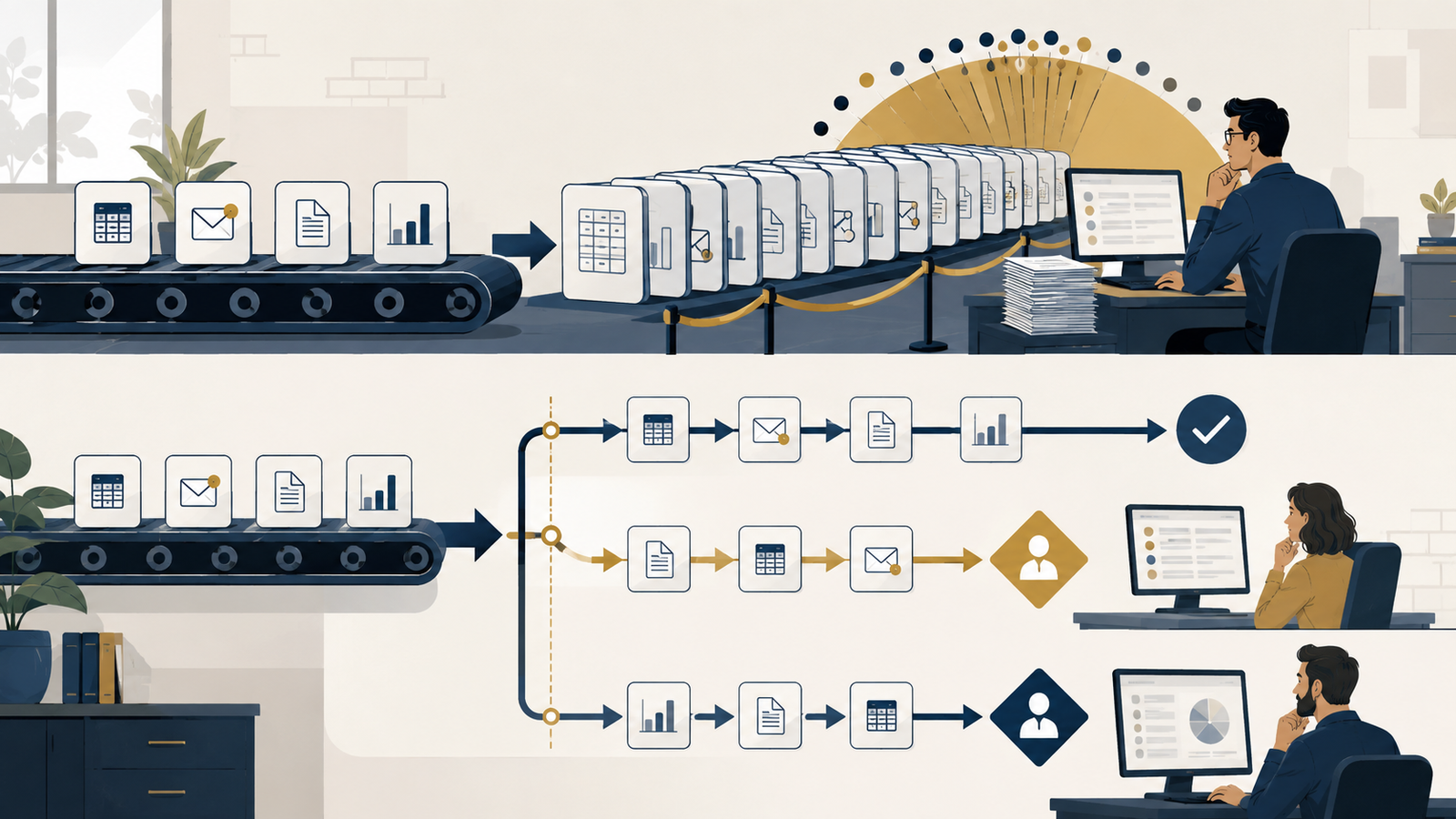
A customer needs an answer, but the employee handling the request cannot provide one until a manager approves it.
The manager is busy, so the request waits. When the manager finally opens it, there is little to evaluate. The amount is routine, the information is complete, and the decision is almost always yes. The manager clicks approve, the employee resumes the work, and everyone treats the delay as a normal part of doing business.
This pattern appears responsible because an approval sounds like control. But an approval that does not produce a meaningful decision is not necessarily protecting the business.
It may simply be a queue.
Approval bottlenecks create more than inconvenience. They slow customer service, interrupt employees, concentrate routine work around a few people, and encourage unofficial workarounds. They can also create the illusion of oversight while nobody is actually evaluating the underlying risk.
The goal is not to eliminate approvals. It is to ensure that every approval earns its place in the process.
Why approval steps accumulate
Most unnecessary approvals were not created with the intention of wasting time. They usually began as a reasonable response to a particular concern.
A costly mistake occurred, so another reviewer was added. An employee exceeded their authority, so all similar requests began going to a manager. A growing company kept the approval structure it used when every decision still passed through the owner. A software template included an approval field, so the business adopted it without questioning whether it was needed.
Over time, the original situation changes, but the approval remains.
This is how a temporary safeguard becomes permanent operational friction. Nobody owns the decision to remove it, and leaving it in place appears safer than challenging it.
The result is a process shaped by accumulated caution rather than current risk.
Approval is valuable when a decision is being made
A useful approval has a clear purpose. The approver may be:
- Confirming that a financial commitment falls within budget and authority
- Evaluating a legal, regulatory, safety, cybersecurity, or privacy risk
- Resolving an exception that falls outside established rules
- Verifying that required evidence is present before an irreversible action
- Accepting accountability for a consequence the requester is not authorized to accept
- Coordinating a decision that materially affects another part of the business
In each case, the approver contributes judgment, expertise, authority, or risk acceptance.
Now compare that with an approval in which the reviewer routinely checks that a form is complete, confirms information already validated by the system, or approves nearly every request without changing the outcome.
That may not be approval at all. It may be quality control, notification, recordkeeping, or habit—each of which can be handled differently.
The rubber stamp is not harmless
An approval that almost never changes the outcome can still create significant consequences.
Work waits in invisible queues
The task may require only a few minutes of effort, but it sits for hours or days between steps. The business measures the work time and misses the waiting time, even though the customer experiences both.
Managers become routing systems
Supervisors spend attention moving ordinary requests forward instead of addressing exceptions, developing employees, or making higher-value decisions. Their inbox becomes part of the workflow infrastructure.
Employees learn to bypass the process
When the formal route is too slow, employees send text messages, seek verbal approval, reuse an old authorization, or complete the work first and document it later. The business then loses the visibility and accountability the approval was supposed to provide.
Responsibility becomes less clear
Multiple approvals can create the impression that everyone is accountable while no one truly owns the decision. Each reviewer assumes someone else performed the substantive check.
Customers absorb the delay
Internal approval time eventually becomes an external problem: slower quotes, delayed refunds, missed purchasing windows, longer onboarding, or an employee who cannot resolve a routine customer concern.
Urgent requests become the normal exception
Teams learn that the only reliable way to move work is to mark it urgent. When everything is escalated, leaders cannot distinguish a real emergency from a process that is routinely too slow.
A familiar small-business example
Imagine a service business that requires the owner to approve every customer credit, regardless of amount.
The policy was created after a large credit was issued incorrectly. Requiring the owner’s approval seemed like a reasonable control. But most requests are small, well documented, and caused by familiar service issues. The owner approves nearly all of them.
Meanwhile:
- Customers wait for routine corrections
- Employees repeatedly interrupt the owner
- The owner becomes a single point of failure
- Staff sometimes promise a credit before approval because they expect it to be granted
- The same review effort is applied to a $20 adjustment and a $2,000 dispute
The problem is not that approval is always unnecessary. The problem is that the control does not distinguish between levels of risk.
A better design might allow trained employees to issue documented credits up to a defined threshold, require a supervisor to review larger amounts, and reserve owner approval for high-value or unusual cases. Periodic reporting could make patterns visible without forcing every routine decision through the same person.
Oversight remains, but it is placed where it adds value.
Use thresholds instead of treating every request alike
Many approval bottlenecks exist because a business applies its most cautious process to every transaction.
Risk-based thresholds can preserve control while allowing routine work to move. Depending on the process, thresholds might be based on:
- Dollar value
- Sensitivity of the information involved
- Whether the request follows a standard pattern
- Whether the action can be reversed
- The employee’s training or delegated authority
- The potential effect on customers, operations, security, or compliance
- Whether an exception to policy is being requested
The lowest-risk work may proceed within established rules. Moderate-risk work may require one appropriate reviewer. High-risk, unusual, or irreversible decisions may justify additional scrutiny.
The point is not to reduce control indiscriminately. It is to match the control to the consequence.
Separate approval from notification
Sometimes a manager does not need to authorize an action but does need visibility into it.
Those are different requirements.
If the work can proceed unless a manager intervenes, a notification may be sufficient. If the manager needs awareness of trends rather than individual transactions, a weekly report or dashboard may be better. If the purpose is to confirm that required information is present, a checklist or system validation may be more reliable than waiting for a person to inspect every field.
Ask what the business actually needs:
- Permission: Work cannot proceed until someone accepts the decision.
- Verification: Someone confirms that defined requirements are satisfied.
- Consultation: Expertise is needed before the decision is made.
- Notification: A stakeholder needs awareness but does not control the outcome.
- Reporting: Leadership needs patterns and exceptions, not every individual item.
Calling all five activities “approval” creates unnecessary waiting and hides the real purpose of each step.
Audit an approval with seven questions
Choose one recurring process that employees describe as slow and examine each approval step.
- What specific decision is this person making? If the answer is unclear, the approval may not have a defined purpose.
- What information does the approver evaluate? Identify the evidence, standard, threshold, or expertise used—not merely the fields they can see.
- How often does the approver reject, modify, or return the request? A near-perfect approval rate does not automatically make the step unnecessary, but it should prompt investigation.
- What risk would increase if this approval were removed or changed? Describe a credible consequence rather than relying on “we have always required it.”
- Could rules, thresholds, training, or system validation manage that risk? The answer may be delegated authority rather than another checkpoint.
- How much time does the request spend waiting? Measure total elapsed time, not only the minutes people actively work on it.
- What happens when the approver is unavailable? A process that stops when one person is absent contains a continuity risk.
Do not evaluate these questions only with managers. Employees who submit requests often know where the actual delays, repeated questions, and unofficial shortcuts occur.
Remove approvals carefully
An unnecessary approval should not be deleted without understanding why it was created.
Review applicable legal, contractual, financial, safety, cybersecurity, privacy, and insurance requirements. Examine prior incidents and common exceptions. Define who will hold authority and accountability after the change. Establish thresholds, documentation standards, monitoring, and escalation paths.
Then test the revised process on a limited scale.
Track processing time, error rates, exceptions, customer impact, and employee workarounds. If risk increases, adjust the control. If work moves faster with no meaningful loss of protection, expand the change.
The objective is not fewer approvals as a performance metric. It is better decisions with less unnecessary waiting.
A control should control something
Small businesses often depend heavily on the owner or a small leadership team. That makes it easy for routine approvals to accumulate around the same people until they become the constraint on the entire operation.
More approval does not automatically mean more accountability. In some cases, it creates slower work, weaker ownership, and more pressure to operate outside the approved process.
Every approval should answer three questions:
- What decision is being made?
- What risk is being controlled?
- Why is this the right person to control it?
If the business cannot answer those questions, the approval may not be protecting the process. It may simply be standing in its way.